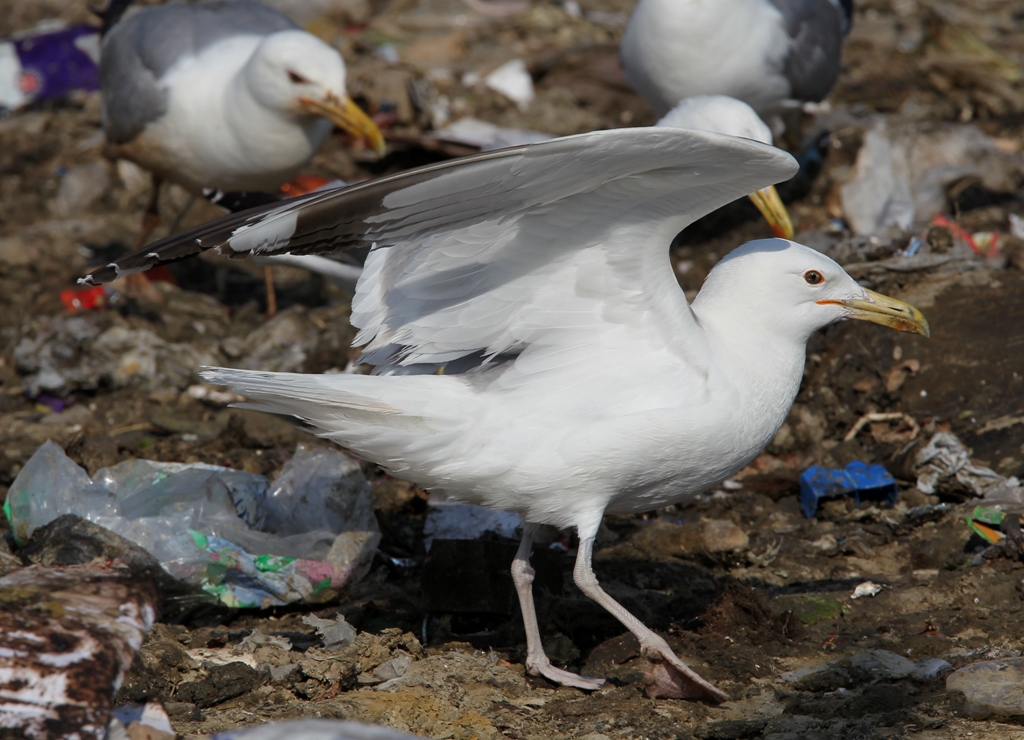
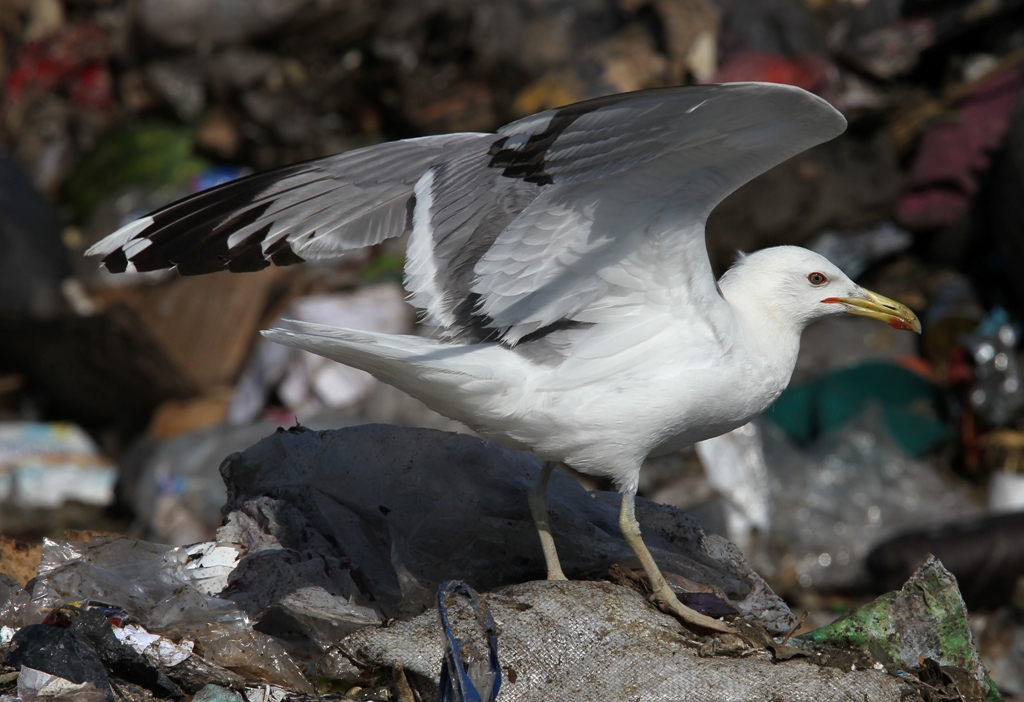
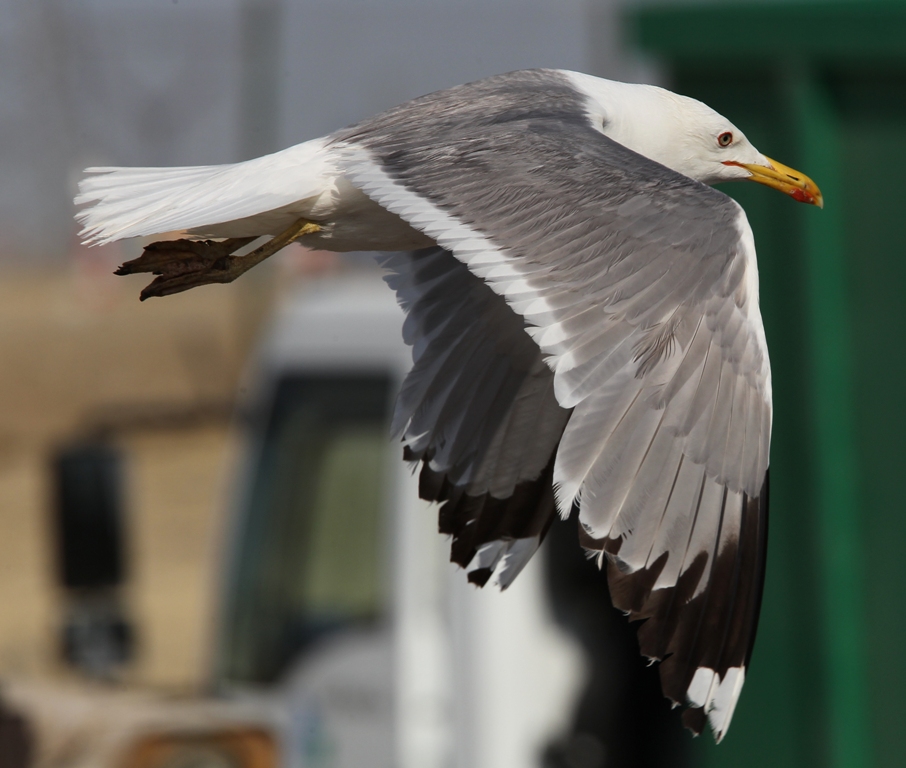
Hannu Koskinen, Visa Rauste and myself visited Azerbaijan this summer (21 June-4 July) the study its breeding gulls. We were extremely fortunate and managed to obtain lots of material on the gulls, notably visiting Baku landfill site and a breeding island in the Caspian that contained more than 1000 breeding pairs. I have not had time to do any analysis of this material, but thought it worthwhile to post some examples on the blog of the birds we were seeing. As far as I can establish, very little material exists (is available/published) showing what these eastern Caspians look like, so I hope that the pictures posted here form a useful resource. I've highlighted below, in one or two images, things of specific interest. Unless stated otherwise, each photo shows a different individual. All these images were from Baku landfill site.
A classic Caspian Gull pattern, similar/identical to many western ponticus
Note the length, shape and colour of the P10 tongue, compared to others highlighted below (and relative to the ponticus birds we see in Europe)
Slightly longer tongue than the bird highlighted above, but similar smooth shape
Note serrated and almost diffuse edge to p10 tongue
A different, jagged-edged tongue.
An intermediate/short tongue, with the length of the white tip shorter than the length of the black band. Tongue distincly grey, rather than pure white.
Very bright bare parts and a rather pale eye.P10 typical Caspian.
Scary short P10 tongue
Above are a couple of birds with extensive black across the tip of P10 .
A bird with a thayeri pattern on P9 and 10. That such birds exist in the east is notable.
The same individual is shown in the above 2 images
Rather a lot of black in the wingtip - note extensive black in tip of P10, small P9 mirror and black to P4.
A close up of a bird with only one or two speckles in the eye. In most field views this would look pale eyed.
thayeri patterns
Rather robust bill and short P10 tongue
Limted inward extension of black in the primaries.
Now for some examples of more problematic birds. This bird has rather a lot of black in the outer two primaries, and looked a fraction darker grey in the field. Steppe Gull (
barabensis) should not be in Azerbaijan in summer; to my eye (in field views) it was not dark enough for
barabensis but tricky to judge this in the bright, sunny conditions. Of course much remains to be determined and it may be that
barabensis is breeding in this area; we had a few 2 cy birds that appeared to be this taxon..
Same bird is shown above and below. Rather bright bare parts and a pale eye, and a distinctly grey P10 tongue. Ive seen
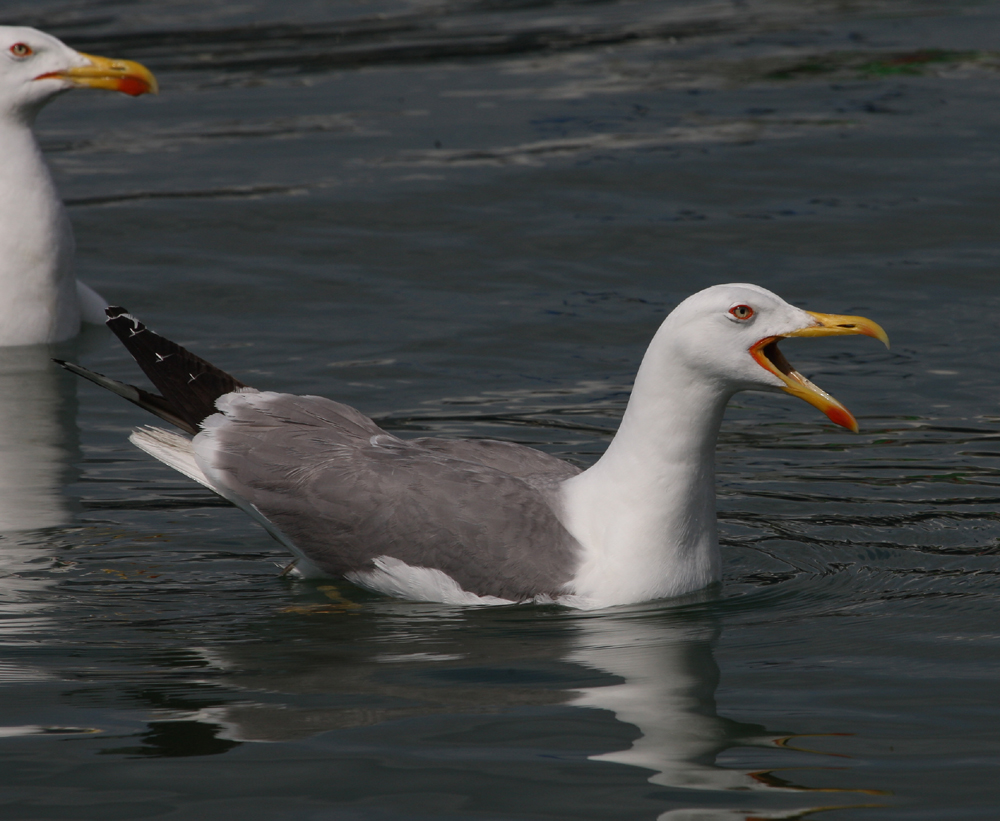
michahellis in Romania like this (e.g. the final image below). We had another bird that was even more like Yellow-legged Gull; this bird will be featured elsewhere so I've not posted it here.
Yellow-legged Gull, Mamaia, Romani (January) This primary pattern is very like some birds seen in Azerbaijan. Food for thought.