I am currently trying to make sense of birds such as these, and am working on a small project which aims to assess whether there are any criteria which can be used to separate pure but unusual cachinnans from hybrids. I have put the pictures on this blog so that collaborators on this project can view these birds and we can discuss them. But at the same time, they are available here, such that birders with an interest in this species can muse over the problems posed by birds such as these.
I have simply included factual data (location, date) for each plate and commented briefly on points of interest - features that are not normally associated with cachinnans. One or two of the birds have featured on earlier posts on this blog.
 Bird 1. Romania, August. Very dark looking, due to wear on pale feather fringes. Jizz very typical cachinnans.
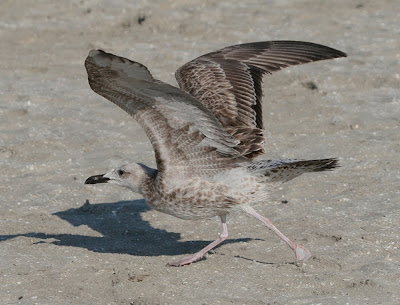 Bird 1. Romania, August.
  Bird 1. Romania, August. Extensively dark tail and heavily marked rump and upper tail coverts .
 Bird 2. Lithuania, September. Such well marked greater coverts are unusual.
 Bird 2. Lithuania, September. Jizz and underwing typical cachinnans.
Bird 3. Latvia, April. Possible hybrid cachinnans x argentatus, ringed as chick in mixed species colony in Eastern Latvia, but exact parentage not determined by the ringer.

Bird 3. latvia, April. Terrible photo, but shows underwing pattern.

 Bird 5. Lithuania September. Note greater coverts
 Bird 6. Lithuania September. This does not seem to match anything perfectly
Bird 7. Lithuania September. Beautiful cachinnans jizz but this plumage type overlaps with Herring Gull

Bird 7. Lithuania September. Underwing good for cachinnans but appears to lack P10 mirror.
 Bird 8. Lithuania September. Plumage dark but pattern resembles cachinnans. And of course jizz very good.
 Bird 8. Lithuania September.


 Bird 9. Lithuania.
 Bird 9. Lithuania September.
 Bird 9. Lithuania September.
  Bird 10. Romania, 12 September. This bird is very like the Lithuanian bird above (bird 9) but it is from the breeding range of cachinnans. The jizz is odd, but looks neither like michahellis or argentatus. Seems early for a 1 cy heuglini to have reached Romania, and would not expect so many second generation feathers this early.
 Bird 10. Romania.
 Bird 11. Latvia, April. Heavily streaked for cachinnans of this age (3 cy) but call and long call posture (see below) fit cachinnans.
 Bird 11. Latvia, April.
 Bird 12. Lithuania, September. A rather dark bird with a jizz that, at least to me, does not immediately say cachinnans.
 Bird 13, Lithuania, September. This bird sounded like a cachinnans!
 Bird 13. Lithuania September.

 Bird 14. Second generation scapulars very heavily marked.
 Bird 14.
 Bird 8. Lithuania September. Plumage dark but pattern resembles cachinnans. And of course jizz very good.
 Bird 8. Lithuania September.
 Bird 8. Lithuania, September. Rump and tail coverts very heavily marked.
Bird 9. Lithuania September. Very heavily streaked on head and neck.
 Bird 9. Lithuania.
 Bird 9. Lithuania September.Bird 9. Lithuania September.
  Bird 11. Latvia, April. Heavily streaked for cachinnans of this age (3 cy) but call and long call posture (see below) fit cachinnans.
 Bird 11. Latvia, April. Bird 12. Lithuania, September. A rather dark bird with a jizz that, at least to me, does not immediately say cachinnans.
 Bird 13, Lithuania, September. This bird sounded like a cachinnans!
 Bird 13. Lithuania September.
 Bird 14. Lithuania , September. Another dark 1cy
Bird 14. Second generation scapulars very heavily marked. Bird 14.
 Bird 14.
 Bird 15. Seems to show some pro- cachinnans features but other things reminiscent of michahellis. Unfortunately I dont have any other pics of this bird.
Bird 15. Seems to show some pro- cachinnans features but other things reminiscent of michahellis. Unfortunately I dont have any other pics of this bird.Bird 16. Latvia, August.
 Bird 16. In my opinion this is cachinnans but actually it is not too hard to find Herring Gulls that match this plumage (except for underwing)
 Bird 16.
 Bird 17. Latvia, August. Same comments apply as with bird 16.


Bird 16. In my opinion this is cachinnans but actually it is not too hard to find Herring Gulls that match this plumage (except for underwing) Bird 17. Latvia, August. Same comments apply as with bird 16.
 Bird 17.
Bird 18. Lithuania, September. Very like the bird below.
Bird 19. Lithuania, September.
Bird 20. Romania, September. Several features more like michahellis, but underwings rather white.
Bird 20. Romania, September.
Bird 21. Lithuania, September. Ive shown this bird to people who think it is diffuclt to ID this as cachinnans. More pics of it are below. My view is that it is cachinnans.
 Bird 21.
 Bird 21. Inner primaries are at the dark end of the spectrum.
 Bird 22. Romania, August. In Romania, it is not too hard to find 'eastern' michahellis whose plumage matches this. But behaviour and underwing match cachinnans.
 Bird 22.
 Bird 23. Lithuania, September. A pale-eyed, streaky headed near adult.
 Bird 24. A similar bird from Romania, also in early-mid September.
 Bird 24.
 Bird 24.
 Bird 25. Lithuania, September. Another streaky-headed, pale eyed bird. Together these things give it a facial expression rather unlike cachinnans.
 Bird 26. Lithuania, September. Jizz more like Herring Gull, but plumage overlaps easily with cachinnans. It has a P10 mirror.
 Bird 26.
 Bird 26.


Bird 23. Lithuania, September. A pale-eyed, streaky headed near adult. Bird 24. A similar bird from Romania, also in early-mid September.Bird 24.
 Bird 24.
 Bird 25. Lithuania, September. Another streaky-headed, pale eyed bird. Together these things give it a facial expression rather unlike cachinnans.
  Bird 26. Lithuania, September. Jizz more like Herring Gull, but plumage overlaps easily with cachinnans. It has a P10 mirror.
 Bird 26.
 Bird 26.
 Bird 27. Lithuania, September. Exceptionally bright bare parts
Bird 27. Note p10 pattern.
 Bird 28. This next sequence of photos show variation in P10 pattern of Romanian birds.
 Bird 29. Romania, September. Short tongue.
 Bird 30. Romania, September.
 Bird 31. Romania, September.

 Bird 34. Finland, August. Jizz, underwing and call all fit cachinnans, but heavily marked
 Bird 34.
 Bird 34.
 Bird 35. Latvia, February. Bright bare parts for a 3rd winter bird, and rather bulging gonys.
 Bird 35. Lacks the tongues on P9 and 1o seen on some cachinnans of this age.
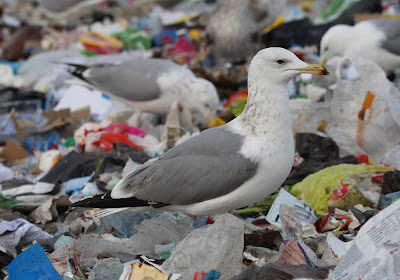 Bird 35.
 Bird 28. This next sequence of photos show variation in P10 pattern of Romanian birds.
 Bird 29. Romania, September. Short tongue.
 Bird 30. Romania, September.
 Bird 31. Romania, September.
Birds 32 and 33. A pair (note bonding behaviour) but with rather different bare part colours; rear bird has robust bill.
 Bird 34. Finland, August. Jizz, underwing and call all fit cachinnans, but heavily markedBird 34. Bird 34.
 Bird 35. Latvia, February. Bright bare parts for a 3rd winter bird, and rather bulging gonys. Bird 35. Lacks the tongues on P9 and 1o seen on some cachinnans of this age.
  Bird 35.


 Caspian Gull; a large, presumably male bird.
 Caspian Gull. Same bird as above. The bill colouration, rather short P10 tongue and black across the tip of P10 suggest that this bird is not fully mature.

 Presumed Caspian Gull. This 3w bird called like a cachinnans, but one or two things concern me a little. Its bill is rather bright and, especially visible in the image below, bulges at the gonys; it also has rather a lot of neck streaking. Collectively, these features make it a less than typical bird. If I was in UAE, without the call I would just take this to be a barabensis.
