


 These images are all from 14 April.
 Still around 10 white winged gulls present at Peterhead yesterday (Sunday 18 March). This post shows a selection of the birds.
 First (above) and second (below) winter Glaucous have both been around for several weeks

 The first winter bird
 First winter Glaucous
 Iceland Gull: here are a few of the birds present at the weekend.


 Here is a Common Gull that I saw briefly (very frustrating) at Peterhead on 26 February. I've been playing around with criteria to identify heinei Common Gull and it turns out that this bird is a perfect match. Here are the images; some text and analysis follow...
 It is the left hand bird in these two flight pics.
 Sailed eider from yesterday! What an absolute stunner. This is what we are currently referring to as a 'type 1' sailed eider (combining large pointed sails with an orangy bill).
  Displaying.
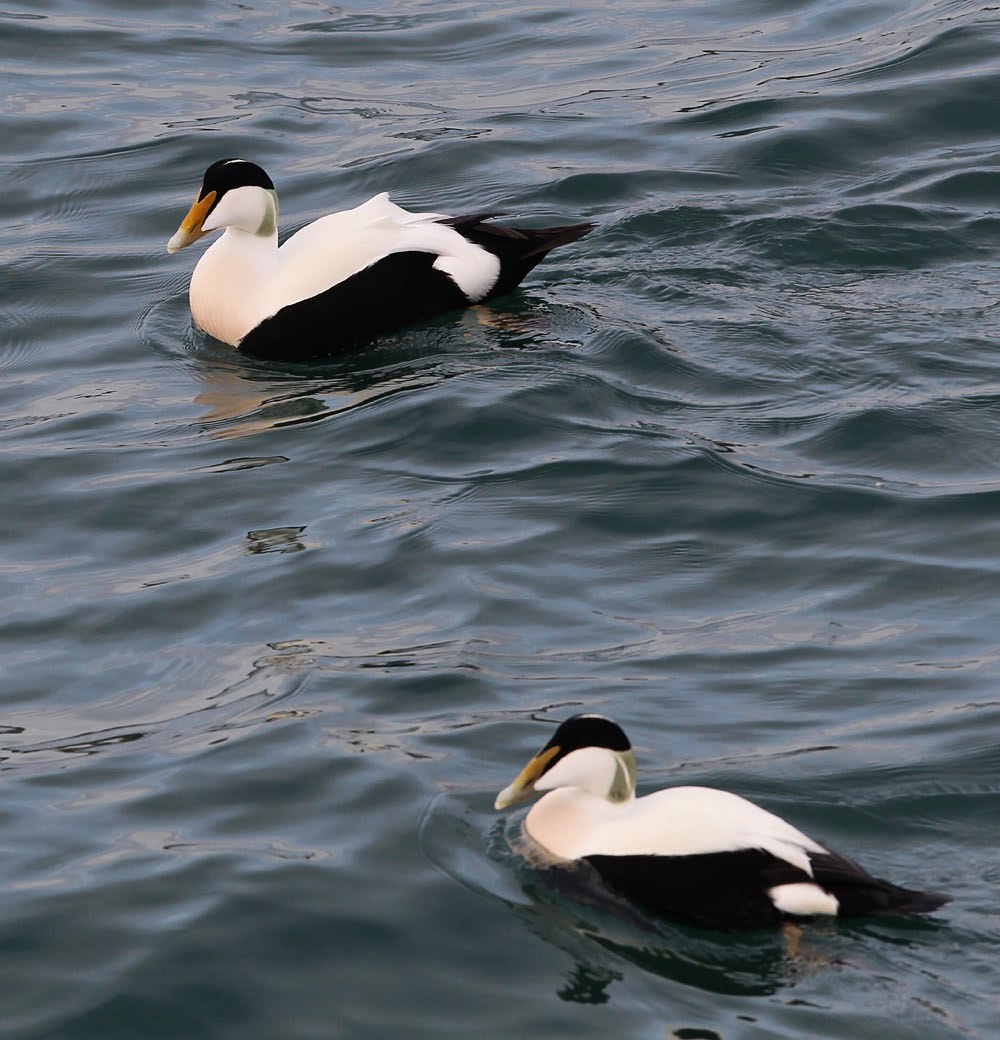 In comparison with molissima
  Another fascinating bird from Peterhead yesterday. Although it has dark outer webs to the primaries (i.e. just like a Kumliens), this pattern extends inwards all the way to P1 and is actually a touch stronger on the inner than the outer feathers. The problem is working out whether the outer feathers are faded more than the inner ones (which you would expect, given how wings fold) and hence whether it would have shown the full kumlien's pattern when fresh (outer prims with darker outer webs then the inner primaries) . No doubt many Kums in NF are looking like this at the moment. What a great bird to puzzle through. Maybe I'm too critical and conservative? Comments welcome!
 A close up of its primaries - how did we cope before digital cameras!
 Many many thanks to Luka Jurinovic and his team for organising what was a highly succesful IGM. The talks were most enlightening, the rubbush dump was full of gulls, the delegates were a great bunch of enthusiastic, knowledgeable and helpful people, and the food was superb; thanks Luka. Here we all are (above) on Zagreb dump.
 Caspians of all ages were present - here are some examples


 For the ringers, there was an opportunity to catch some great birds....
 michahellis...mmm....seems to be....
 .....but look at this P10 tip and tongue...more on such birds later.....
  All these birds are from Peterhead at the weekend. Above is a dark bodied Herring Gull; dark bodied birds are not uncommon, but this bird is not only dark, but the dark tones are rather velvety, giving it a 'Neararctic feel', and contrasts with the pale head. Otherwise it is a normal Herring Gull (in terms of tail pattern etc).
 Numbers of Iceland Gulls have dropped off (around 10 were present) but still impressive. All the remaining shots show a selection of individuals present at the weekend.


 Despite the shadowing in the primaries, this is a glaucoides.
 Tesco 47 p per loaf bread has been a winner during the white-winged invasion. At the peak 0f the invasion a couple of weeks ago the ratio was more than 1 white-winged gull for every loaf used (averaging 20 loaves per weekend). The peak is over, birds appear to be moving off and now im only seeing around 12 white-wings for my 20 loaves - so ratio poorer than 1:1 :)


 Same place, same day, but very four different birds. Here are some Herring Gulls from Peterhead yesterdy. Above (right) is an odd, petite bird, especially a small and pointed bill. In flight (see the two images below) it showed very silvery and contrasting inner primaries. It has retained juv scapulars and an odd tertial pattern.

 A very pale bird, but combined with a rather extensively dark tail and well barred rump . Pale panel in the greater coverts scared me for a moment (ie. you never know, we might get a 1w Slaty-backed Gull one day) , but actually these coverts are rather well patterned and simply worn/faded (rather than being the uniform panel seen on SBG).
  A nice muddy argentatus.
 Its tail and upper tail coverts are nothing to get excited about.
 An exceptionally dark bodied bird.
  Tail is towards dark end for Herring Gull, but rump and upper tail coverts pattern is seen in many Herrings. I wonder whether we have got some birds that have come from the same places all all the Iceland Gulls?


